Property Risk Assessment: Spatial AI Finds Hidden Risks in Australia
This tool is a generic calculator and does not advertise or promote a specific financial product. It is not intended to be relied on for the purposes of making a decision in relation to a financial product. You should consider obtaining advice from a financial services licensee before making any financial decisions.
Property Risk Assessment: Spatial AI Finds Hidden Risks in Australia
A property risk assessment identifies hazards, rates their likelihood and consequence, and sets controls to reduce them to an acceptable level. In Australia, this duty sits with the Person Conducting a Business or Undertaking, or with the property owner where no PCBU is engaged, and it feeds directly into the hierarchy of controls, insurance clarity and legal compliance.
TL;DR:
- Before visiting, review insurance schedules, maintenance logs, and the Section 32 vendor statement, then check planning overlays, flood and bushfire designations, and contaminated land registers.
- Rate likelihood and consequence as low, medium, or high; refer hazards rated high on both scales to the relevant licensed specialist before budgeting remediation.
- Fund controls in order of effectiveness: eliminate or substitute hazards first, use engineering measures next, then administrative rules, and reserve personal protective equipment for last.
- For NSW, interim inspections occur around 15 to 18 months after completion and final checks between 21 and 24 months; missed windows can weaken claims.
- Keep a risk register with responsible parties, remediation dates, budgets, and inspection history, and revisit it annually as conditions and occupancy change.
Table of Contents
- Key steps in a property risk assessment
- How to run a defensible property risk check
- Legal and compliance essentials in Australia
- Prioritising controls with the hierarchy approach
- How spatial audits speed up hidden-risk discovery
- Make risk assessment routine, not reactive
- Getting an independent audit through OptiWealth FairBid
- FAQ
- Sources
Key steps in a property risk assessment
A defensible assessment follows a sequence rather than a single inspection. Each step narrows the gap between what a property appears to be and what it actually exposes its occupants, owners and insurers to.
- Map the asset and its users: record building type, age, occupancy pattern and high use areas such as loading docks, plant rooms or shared stairwells.
- Inspect structural, fire, electrical, asbestos and service risks: this covers the physical fabric, from roof condition to switchboard compliance and any materials consistent with older construction methods.
- Check planning overlays, title encumbrances and the Section 32 vendor statement: bushfire management overlays, flood zones and easements change what an owner can build, insure or claim.
- Assess security, human and operational risks: access control, lighting, contractor management and incident history all shape the likelihood and consequence ratings.
- Produce findings with prioritised controls, a timeline and a cost estimate: a report without a sequence and a budget rarely gets acted on.
The Queensland government’s property level risk assessment guidance sets out a template many owners and managers adapt directly, pairing each hazard with a responsible party and a review date. For commercial property specifically, this sequence also supports asset risk analysis across a portfolio, since the same categories (structural, environmental, security, operational) apply whether the asset is a single tenancy or a multi-building estate.
How to run a defensible property risk check
Before any site visit, gather the paperwork that tells you what has already been disclosed or flagged: insurance schedules, maintenance logs and the Section 32 vendor statement for any property under contract. Standard pest and building reports rarely capture planning overlays or special levies on their own, so a due diligence checklist from Consumer Affairs Victoria is a useful cross-check against what a private inspector provides.
Desktop checks come first:
- Planning maps and council overlay registers for the subject property and surrounding suburb.
- Flood and bushfire-prone area designations held by the relevant state planning authority.
- Contaminated land registers, particularly for former industrial or agricultural sites, covered in more detail in our contaminated land search guide.
On-site checks follow:
- Visible structural movement, cracking or water ingress around footings and roofline.
- Roof condition, guttering and drainage falls away from the building.
- Fire doors, egress paths and switchboard labelling and condition.
- Indicators of asbestos-containing materials in pre-1990 construction, discussed further in our asbestos management guide.
A simple categorical score, likelihood multiplied by consequence, each rated low, medium or high, gives a defensible basis for prioritisation. Any hazard scoring high on both axes should trigger a referral to a structural engineer, environmental auditor or licensed asbestos assessor before any remediation budget is set.
Pro Tip: Photograph every defect with a timestamp and a reference point, such as a tape measure or doorframe, so the evidence stands up later in an insurance or strata dispute.
Legal and compliance essentials in Australia
Under Australian WHS law, a PCBU must identify, assess and control hazards, applying the hierarchy of controls where elimination is not possible. This duty is ongoing, not a one-off exercise completed at handover.
Bushfire management overlays and bushfire-prone area designations can trigger mandatory construction standards and ongoing permit obligations. Planning for Bush Fire Protection (PBP 2026) is the principal NSW statutory instrument governing development on bush fire prone land, and comparable BPA and BMO frameworks apply in other states.
For strata buyers and owners corporations, the Strata Building Bond and Inspections Scheme requires developers to lodge a building bond, with interim inspections occurring around 15 to 18 months after completion and final inspections between 21 and 24 months, a process that can be streamlined using off the plan marketing tools to ensure compliance and timely documentation. Missing these inspection windows can reduce an owners corporation’s ability to claim against defective building work.
Prioritising controls with the hierarchy approach
Once hazards are scored, the hierarchy of controls determines what gets funded first rather than what is cheapest to announce.
- Eliminate or substitute where feasible, such as removing a hazardous material entirely rather than encapsulating it.
- Apply engineering controls next, like upgrading switchboards or installing ember-proof vents in a bushfire overlay zone.
- Add administrative controls, such as restricted access schedules or contractor induction processes.
- Use PPE as the last layer, never the first response to a structural or environmental hazard.
Documented controls change the conversation with insurers and boards: a schedule showing remediation dates and responsible parties supports premium negotiations and budget approval far better than an unranked list of concerns.
How spatial audits speed up hidden-risk discovery
Standard building and pest reports do not reliably capture planning overlays, special levies or signals consistent with auction underquoting. Independent spatial AI audits, such as OptiWealth FairBid, screen these layers alongside structural defect indicators and latent holding-cost risks like unbudgeted special levies, giving buyers and managers a quantitative view before contracts are signed.
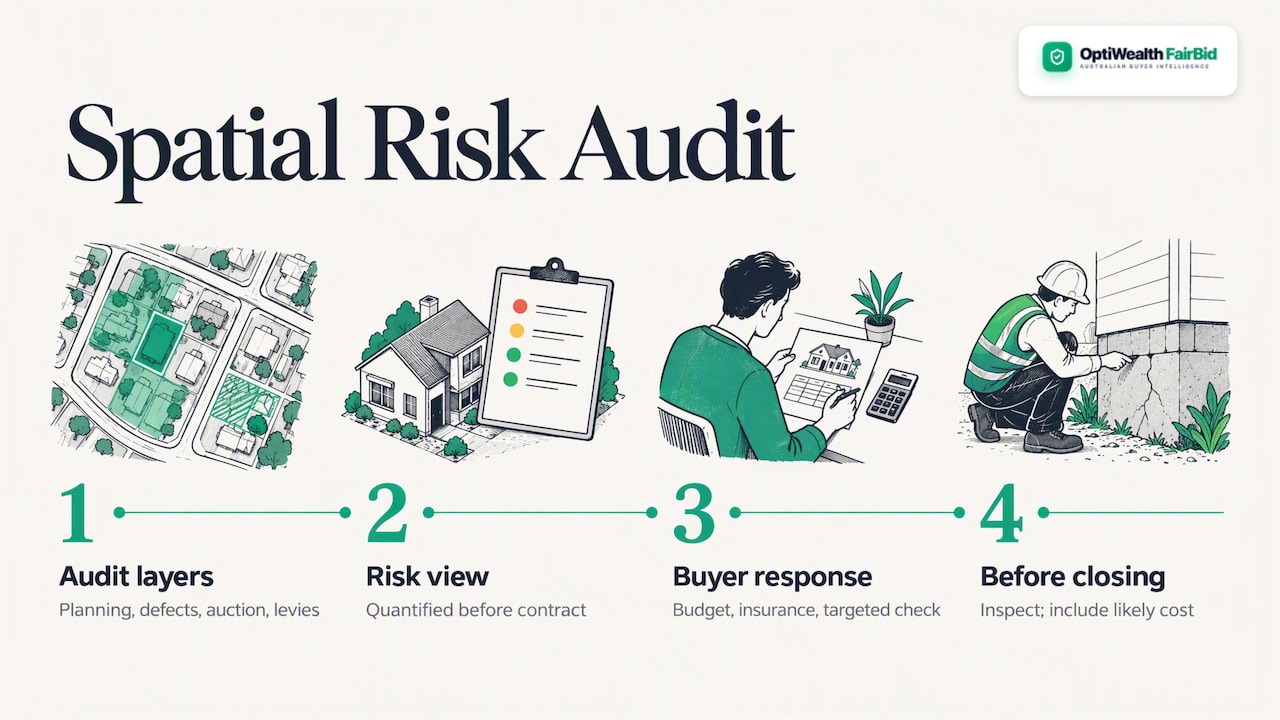
A buyer using this kind of audit can adjust a purchase budget, renegotiate insurance terms or instruct a targeted structural inspection based on what the report flags, rather than discovering a council overlay or a looming special levy after settlement. The practical next step after any audit is the same: commission the specific specialist inspection the report points to, and fold the likely cost into the acquisition budget before the deal closes.
Make risk assessment routine, not reactive
Too many owners treat a property risk assessment as a pre-purchase formality rather than a recurring discipline. The stronger approach embeds it into acquisition checklists and annual asset management cycles, so structural, environmental and compliance risks get reviewed on a schedule rather than discovered during a dispute or a claim.
Coordination matters as much as the inspection itself: tenants, strata managers and insurers each hold a piece of the risk picture, and a simple risk register tracking remediation dates, budgets and inspection history keeps that picture current rather than scattered across inboxes.
— JeongSuk Lee
Getting an independent audit through OptiWealth FairBid
Before committing capital to a property, we built OptiWealth FairBid to give buyers and managers an independent read on exactly the risks this guide covers: overlay exposure, defect screening and valuation intelligence, delivered as a downloadable audit report rather than a sales pitch dressed up as advice.

Our free tier gives you a starting view of a property’s risk profile, and a paid tier unlocks the full quantitative breakdown, including overlay detection and holding-cost analysis. For strata purchases specifically, our strata report breakdown explains how this output applies across NSW, Queensland and Victoria. Readers weighing up a contract price against a risk profile can also preview a sample property audit before purchasing, and those negotiating off a defect list may find our underquoting and negotiation guide useful alongside it. Start with the sample report, then decide whether the full audit earns its place in your due diligence budget.
FAQ
Can I write my own risk assessment?
You can conduct your own property risk assessment using a structured template, such as the Queensland government’s property level guidance. Complex hazards such as structural defects, asbestos or bushfire overlay compliance generally need a licensed specialist to sign off before the assessment holds up for insurance or legal purposes.
How big is the property industry in Australia?
The total value of Australian residential dwellings reached about $12.3 trillion in the December 2025 quarter, with a national mean dwelling price of around $1.07 million. That scale underlines why hidden risks, from undisclosed overlays to underquoted auction estimates, carry real financial weight for individual buyers.
What is the hierarchy of hazard controls?
The hierarchy of controls ranks responses from most to least effective: elimination or substitution first, then engineering controls, then administrative controls, with personal protective equipment as the last resort. PCBUs are required to work down this hierarchy rather than defaulting to the easiest option.
Who is required to carry out a risk assessment?
Under Australian WHS law, the duty sits with the PCBU, or with the property owner directly where no PCBU is engaged for that site. This duty is ongoing rather than a single pre-occupancy task, and it requires consultation with tenants and contractors as conditions change.
Sources
- Safe Work Australia — managing risks
- NSW Rural Fire Service — Planning for Bush Fire Protection
- Conducting a property level risk assessment — Queensland government
- NSW Government — Strata Building Bond and Inspections Scheme
- ABS — Total value of dwellings, Dec quarter 2025
Recommended
- Decoding Real Estate Risk: The AI Qualitative Engine
- OptiWealth FairBid
- Avoid Settlement Shocks: Contaminated Land Checks in Australia from $34
- House Price Negotiation in Australia: Underquoting, Strata Levers & AI
The information provided in this publication is for educational and general information purposes only and does not constitute financial, investment, taxation, or legal advice under the Corporations Act 2001 (Cth). Property buyers and investors should conduct independent physical, legal, and strata due diligence and seek advice from a licensed financial advisor, solicitor, or conveyancer tailored to their personal objectives before entering into any legally binding contract of sale.
OptiWealth Research
Transparent Data Science & EngineeringData Science, Software Architecture & Mathematical Risk Modeling Group
Authored by OptiWealth’s Quantitative & Data Engineering division. Our team specializes in full-stack software architecture, open-source data science, and spatial econometric property valuation (such as hedonic price regression, environmental zoning overlay synthesis, and cash-flow yield analytics). All underlying algorithms and calculation formulas are fully transparent, open to inspection, and designed purely for financial and property data visualization.
Expose Hidden Property Risks & Liabilities
OptiWealth replaces guessing games with algorithmic diagnostics. Use FairBid to audit council overlays, building defects, and calculate true net property yields.