APRA's 20% Haircut: Make Rental Yield Reliable in Australia

This tool is a generic calculator and does not advertise or promote a specific financial product. It is not intended to be relied on for the purposes of making a decision in relation to a financial product. You should consider obtaining advice from a financial services licensee before making any financial decisions.
APRA’s 20% Haircut: Make Rental Yield Reliable in Australia
A good rental yield in Australia generally sits in the moderate single digits gross for houses and units in established capital city suburbs, with net yield (after costs) typically running noticeably lower. Regional and mining towns can post gross yields above 7%, but location risk, vacancy and climate overlays often erode that advantage. The sections below show how to calculate, verify and stress-test any yield figure before we act on it.
TL;DR:
- Lenders apply at least a 20% haircut to rental income when assessing borrowing capacity, significantly lowering the effective yield used in calculations.
- Regional and mining towns can offer high gross yields above 7%, but location risk and vacancy rates often offset the advantage.
- Yields below 3% are typical for capital city houses but may be acceptable with strong capital growth prospects; yields above 5% require careful risk analysis.
- Conducting a detailed, independent FairBid audit helps uncover hidden costs, overlays, and valuation discrepancies before committing to an investment.
Table of Contents
- What rental yield is and why net vs gross matters
- How to calculate rental yield step by step
- Benchmarks: national averages and practical good-yield ranges
- What reduces or inflates rental yield
- Where to find higher-yield suburbs
- How lenders and borrowing rules change the yield you can rely on
- Practical steps to improve or protect your rental yield
- How an independent FairBid audit changes yield assessment
- Balancing yield, growth and risk in your investment strategy
- Run a FairBid audit before you bid or sign
- FAQ
- Sources
What rental yield is and why net vs gross matters
Gross rental yield is the annual rent a property generates, expressed as a percentage of its purchase price or current market value, known before contracts. Net rental yield subtracts the ongoing costs of holding that property, which is the figure that actually determines cash flow. Conflating the two is one of the most common errors we see in investor decision making, because a suburb advertised with a 6% gross yield might return closer to 3.5% net once costs are counted.
To move from gross to net, we subtract:
- Council rates and water charges
- Strata levies (for units and some townhouses), including any special levies
- Landlord insurance premiums
- Property management fees, typically a percentage of rent collected
- Repairs, maintenance and periodic capital works
- An allowance for vacancy periods between tenancies
Consider a unit purchased for a moderate price and rented at a weekly rate that produces a reasonable gross yield in the mid-single digits. After deducting typical council rates, strata levies, insurance, management fees, and maintenance, annual outgoings reduce net yield by a few percentage points, a gap wide enough to change whether the purchase makes sense.
How to calculate rental yield step by step
Both formulas rely on figures we can confirm before exchanging contracts, not projections from a listing agent.
- Annual gross yield: (weekly rent × 52) ÷ purchase price × 100.
- Annual net yield: (annual rent minus annual outgoings) ÷ purchase price × 100.
- Adjusted net yield: apply a vacancy allowance and a conservative rent haircut before dividing by purchase price.
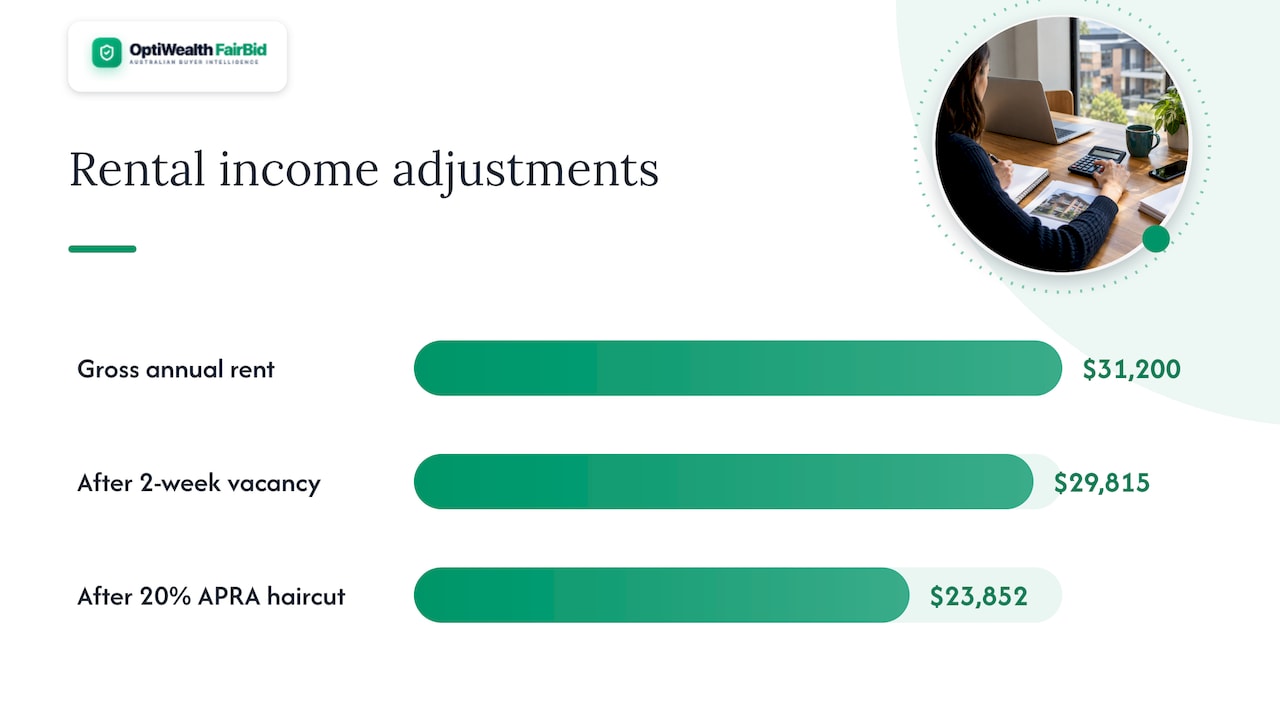
Worked example, a house bought for $650,000 renting at $600 a week: gross rent is $31,200, so gross yield is 4.8%. Deducting $2,800 council rates, $1,400 insurance, $1,872 management fees and $1,500 maintenance leaves $23,628, a net yield of 3.64%.
To adjust further, we apply a conservative two-week vacancy allowance (reducing rent to $29,815) and a landlord haircut consistent with lender practice.
Pro Tip: Model at least one vacancy scenario and one interest-rate-rise scenario before relying on a headline yield to justify a purchase.
APRA guidance recommends lenders apply a minimum 20% haircut to expected rental income when assessing loan serviceability, which means the rent a bank will actually count toward your borrowing capacity is materially lower than the figure in a listing.
Benchmarks: national averages and practical good-yield ranges
National dwelling yields in Australia move in a band shaped by the balance between capital city price growth and regional affordability. Capital cities, where values are higher, tend to sit at the lower end of the yield range, while regional centres and mining towns often sit at the higher end because purchase prices are depressed relative to rent.
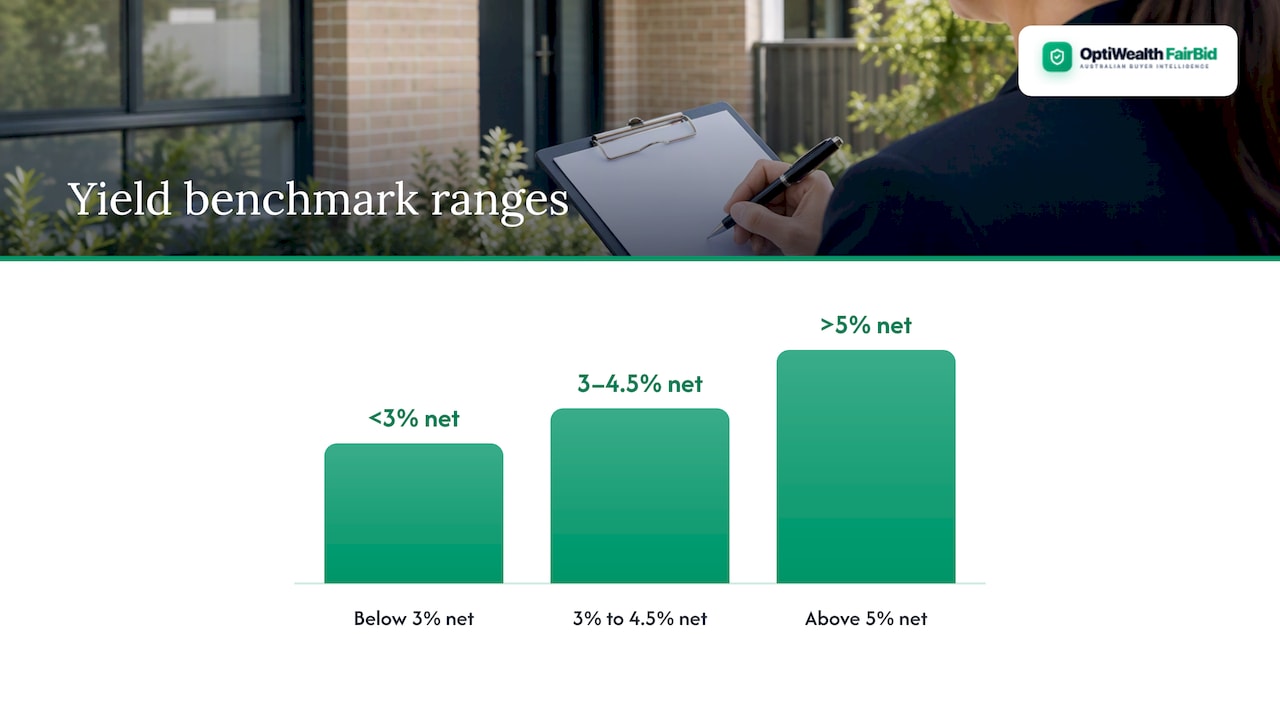
Practical benchmark ranges we use when assessing a property:
- Below 3% net: common in blue-chip capital city houses, acceptable only where capital growth prospects are strong.
- 3% to 4.5% net: a reasonable middle ground for established suburbs with moderate growth and lower vacancy risk.
- Above 5% net: attractive on paper, but warrants scrutiny of location risk, tenant demand and overlay exposure.
A lower yield can still be the right decision when a suburb shows strong population growth, infrastructure investment or low exposure to flood and bushfire overlays, because the long-term return comes from capital appreciation rather than rental income. A property yielding 7% gross is not automatically a better investment than one yielding 4%** once growth prospects and risk are weighed against each other.
What reduces or inflates rental yield
Headline yields published in suburb rankings rarely reflect what a landlord actually keeps. Several factors routinely erode the number:
- Vacancy periods, especially in thin regional rental markets where tenant turnover is high
- Strata special levies, which can add thousands of dollars in a single year for building defects or capital works
- Auction underquoting, where the advertised price range undershoots the eventual sale price, making the yield calculated at purchase lower than expected
- Rising landlord insurance premiums, particularly in flood or bushfire-prone postcodes
- Pest infestations and remediation costs, which reduce net returns in holiday and short-stay rentals if left unaddressed
Climate and insurance risk deserves particular attention. Climate Council analysis with PropTrack finds flood-prone homes are collectively worth around $42.2 billion less than they would otherwise be, and many suburbs face a measurable value penalty tied to flood exposure. A suburb with a strong headline yield but a worsening flood or bushfire overlay can see that yield offset by rising premiums or, in the worst cases, by properties becoming effectively uninsurable.
Pro Tip: Check the flood and bushfire overlay status of any address before weighing its yield, because an uninsurable property can lose both rental income and resale value at once.
Where to find higher-yield suburbs
Suburb lists advertising the highest rental yields in Australia are usually dominated by regional and mining towns, where low purchase prices combine with employment-driven rental demand to produce gross yields well above the capital city average. These figures deserve a cautious read because the same towns can show volatile vacancy rates when a single employer slows hiring.
Before treating any suburb list as a shortlist, we work through this checklist:
- Check median property values against the yield figure, since a small median can distort a yield percentage from a handful of sales.
- Review vacancy rates over at least the past two years, not a single quarter.
- Identify the dominant local employers and assess how exposed the town is to a single industry.
- Confirm planning and zoning overlays, including any flood, bushfire or heritage restrictions that affect future development or insurance.
- Compare property types, because a suburb’s unit yield and house yield can differ by several percentage points, and a published figure may blend both.
- Cross-check sample size, since a suburb with few rental transactions can show an inflated or understated yield purely from a small data set.
ASIC’s guidance on unlisted property schemes warns that valuation methods based on gross rent can overstate a property’s underlying value, a caution worth extending to any suburb list built purely on advertised rent and asking prices. Mining and resource towns are the clearest example: a single project announcement can push yields up for a year or two before a downturn reverses the trend entirely.
How lenders and borrowing rules change the yield you can rely on
Lenders do not use the yield figure in a listing when assessing how much we can borrow against a rental property. APRA’s prudential practice guidance directs lenders to apply a minimum 20% haircut to expected rental income before counting it toward loan serviceability, which means a property advertised at $600 a week is often modelled closer to $480 a week for borrowing purposes.
Practical implications when we model borrowing capacity:
- Use an 80% rent multiplier rather than the full advertised figure when estimating serviceability.
- Expect lenders to prefer verified rental receipts over an agent’s rental appraisal.
- Stress-test the yield against at least one interest-rate rise and one vacancy scenario before committing.
This conservative lender approach is a useful discipline even outside the loan application, because it mirrors the adjusted net yield we should be using to decide whether a property earns its place in a portfolio.
Practical steps to improve or protect your rental yield
Improving yield is rarely about chasing the highest-advertised figure. It usually comes down to disciplined management of the levers already in our control.
- Weigh renovation cost against rental premium before committing. A $20,000 kitchen upgrade that lifts rent by $20 a week takes roughly nineteen years to pay back through rent alone, so renovation decisions should rest on resale value as much as yield.
- Reduce vacancy through tenant retention, using responsive property management and fair rent reviews rather than maximising rent at every lease renewal.
- Budget insurance and overlay risk into every yield calculation, rather than treating it as an afterthought once the property is settled.
- Build a maintenance contingency of roughly 1% of property value a year into the net yield model, so an unexpected repair does not wipe out a year’s cash flow.
Pro Tip: Treat every renovation decision as two separate questions: does it lift rent enough to justify the cost, and does it lift resale value enough to justify it anyway.
How an independent FairBid audit changes yield assessment
A headline yield calculated from a listing price and an agent’s rental estimate carries two blind spots: the true market value of the property and the hidden costs sitting behind council overlays, strata records and structural condition. We built OptiWealth FairBid to close that gap using spatial AI valuation models that compare a property against verified local sales rather than agent-supplied comparables.
A FairBid audit typically surfaces:
- An independent valuation benchmark to replace a quoted or advertised price
- Planning and zoning overlay checks, including flood and bushfire exposure
- Structural defect and strata special levy flags that can materially change holding costs
- A sample audit report showing how these findings translate into an adjusted net yield
In one representative case pattern, a property advertised with an attractive gross yield showed a pending strata special levy once audited, a cost that, once annualised, pulled the net yield down by more than a full percentage point. That is the kind of adjustment a detailed breakdown of hidden liabilities is designed to catch before contracts are signed, not after.
Balancing yield, growth and risk in your investment strategy
Yield and capital growth pull in different directions more often than investors expect, and treating them as substitutes rather than complements is where most strategies go wrong. We tend to favour yield when cash flow funds the next purchase, and growth when the portfolio can absorb a few lean years. Our five-point pre-auction checklist: confirm the adjusted net yield, verify overlay and insurance status, check vacancy history, stress-test at a higher interest rate, and compare the vendor statement against recent comparable sales.
— JeongSuk Lee
Run a FairBid audit before you bid or sign
Turning a headline yield into a number we can actually rely on means checking the valuation, the overlays and the hidden costs before auction day, not after settlement. We offer a free tier providing access to core property checks, with a paid option unlocking the full quantitative audit including overlay risk flags and structural defect screening.

That one-off cost is small next to a strata special levy or an underquoted auction price discovered too late. Start a FairBid audit on OptiWealth before your next bid or signature, and read the yield on any property against the adjusted, independently verified numbers rather than the agent’s.
This article is general information, not a substitute for advice from a qualified financial advisor. Consult a qualified financial professional about your own circumstances before acting on anything here.
FAQ
Is 4.5% a good rental yield?
Net yield at that gross level often lands in the mid-single digits, which is reasonable where capital growth prospects are also strong.
Is 3% a good rental yield?
On its own, without growth potential to offset it, a 3% yield leaves little buffer against rate rises or vacancy periods.
What is the 30% rent rule in Australia?
It is used by policymakers and researchers to assess rental stress rather than to judge whether a property is a good investment.
Is 7% a good yield?
Once typical costs and a vacancy allowance are applied, net yield from a 7% gross figure often sits closer to 4.5%.
Sources
- Prudential practice guide APG 223 – residential mortgage lending
- RG 46 — Unlisted property schemes: improving disclosure for retail investors — ASIC
Recommended
The information provided in this publication is for educational and general information purposes only and does not constitute financial, investment, taxation, or legal advice under the Corporations Act 2001 (Cth). Property buyers and investors should conduct independent physical, legal, and strata due diligence and seek advice from a licensed financial advisor, solicitor, or conveyancer tailored to their personal objectives before entering into any legally binding contract of sale.
OptiWealth Research
Transparent Data Science & EngineeringData Science, Software Architecture & Mathematical Risk Modeling Group
Authored by OptiWealth’s Quantitative & Data Engineering division. Our team specializes in full-stack software architecture, open-source data science, and spatial econometric property valuation (such as hedonic price regression, environmental zoning overlay synthesis, and cash-flow yield analytics). All underlying algorithms and calculation formulas are fully transparent, open to inspection, and designed purely for financial and property data visualization.
Expose Hidden Property Risks & Liabilities
OptiWealth replaces guessing games with algorithmic diagnostics. Use FairBid to audit council overlays, building defects, and calculate true net property yields.