Home buyers and owners: manage asbestos in homes with a property audit

This tool is a generic calculator and does not advertise or promote a specific financial product. It is not intended to be relied on for the purposes of making a decision in relation to a financial product. You should consider obtaining advice from a financial services licensee before making any financial decisions.
Home buyers and owners: manage asbestos in homes with a property audit
If your home was built or renovated before 1990, it probably contains some asbestos-containing material. That is not a reason to panic. Most of these materials carry negligible risk while they remain intact and undisturbed. The priority is simple: avoid disturbing anything you suspect contains asbestos, and arrange a professional assessment before any repair or renovation work begins.
TL;DR:
- Houses built or renovated before 1990 are highly likely to contain asbestos, especially in wet areas, textured coatings, vinyl flooring, and external cladding.
- Visual identification is unreliable; professional sampling and testing by a licensed assessor at a NATA-accredited lab are essential for confirmation.
- Removing friable asbestos requires a Class A licensed removalist, while non-friable asbestos over 10 square meters must also be handled by licensed professionals, with strict state-specific rules.
- In case of suspected disturbance, immediately restrict access, dampen the material, photograph it, and contact professionals; avoid dry sweeping or household vacuuming.
- Managing asbestos in place through an asbestos management plan is often safer and more practical than removal for stable, undisturbed materials.
Table of Contents
- Where asbestos commonly hides in older Australian homes
- How to check for asbestos: inspection, sampling and NATA testing
- Legal duties and removal rules across Australian states
- What to do immediately if you suspect asbestos
- Safe renovation practices and lawful waste disposal
- Asbestos considerations when buying or selling a home
- Why DIY removal carries more risk than it looks
- Long-term health monitoring and symptoms of asbestos exposure
- Living with asbestos: management plans instead of removal
- Treating asbestos as a quantifiable property risk, not a verdict
- Centralising asbestos risk with your broader property due diligence
- FAQ
- Sources
Where asbestos commonly hides in older Australian homes
Asbestos-containing materials, often shortened to ACMs, were used extensively in Australian residential construction until the late 1980s, and homes built or renovated before 1990 are highly likely to contain them. Identifying likely locations helps you brief an assessor accurately and avoid accidental disturbance during everyday maintenance.
Internally, the highest-probability zones are wet areas and anything requiring fire or thermal resistance:
- Wall and ceiling sheeting in bathrooms, laundries and kitchens
- Textured ceiling and wall coatings, sometimes called “popcorn” finishes
- Vinyl floor tiles, their backing, and the underlay beneath them
- Switchboard backing boards, heater insulation and pipe lagging
Externally, the risk extends across the whole envelope of the property: roof sheeting, ridge capping, gutters, downpipes, eaves linings, imitation brick cladding, and the walls of fences, sheds, carports and garages.
A critical distinction sits underneath all of this: friable asbestos crumbles under light hand pressure and releases fibres readily, while non-friable (bonded) asbestos holds fibres within a cement matrix and is comparatively stable. Condition matters more than category. A weathered, cracked or drilled sheet of bonded asbestos can shed fibres just as a friable material does, which is why age and visible deterioration, not material type alone, should drive your caution.
How to check for asbestos: inspection, sampling and NATA testing
You cannot reliably identify asbestos by sight. Many ACMs look identical to standard fibre cement, plywood or vinyl, and a standard pre-purchase building and pest inspection typically excludes asbestos testing altogether, leaving a gap buyers often assume is covered when it is not.
What you can safely do yourself:
- Note the age of the property and any renovation history, since this frames the likelihood of ACMs being present.
- Visually record the condition of suspect materials, flagging anything cracked, crumbling, weathered or previously drilled.
- Avoid any activity that disturbs the material: no power tools, no dry sweeping, no household vacuum cleaners on suspect dust or debris.
Beyond that, arrange for a licensed asbestos assessor to collect samples and send them to a NATA-accredited laboratory for confirmation. A proper assessment report should record every sampled location, the condition of each material, the laboratory results, and clear recommendations for management or removal.
Legal duties and removal rules across Australian states
Removal obligations hinge on two things: whether the material is friable, and how much of it you intend to disturb. Friable asbestos must always be removed by a Class A licensed removalist, the higher of the two licence tiers, because of the elevated fibre release risk. Class B removalists are limited to non-friable material above the quantity threshold that applies to unlicensed work.
- Friable asbestos: Class A licensed removalist required, regardless of quantity
- Non-friable asbestos over 10 square metres: licensed removalist required (Class A or B)
- Non-friable asbestos up to 10 square metres: may fall under a homeowner exception in some states, subject to strict conditions
The 10 square metre exception for non-friable asbestos exists in several states but is a regulatory threshold, not a safety guarantee. Some jurisdictions, Victoria among them, attach additional conditions such as time limits on how long removed material can sit before disposal. Rules differ meaningfully between the ACT, Queensland and New South Wales, covering everything from notification requirements to permitted disposal sites, so checking your state’s WHS authority or EPA guidance before you lift a single sheet is not optional.
Asbestos is linked to thousands of deaths in Australia each year, with many recent mesothelioma cases traced to non-occupational exposure such as home renovation work, which is precisely the scenario these licensing rules are designed to prevent.
What to do immediately if you suspect asbestos
Finding or disturbing suspect material calls for a calm, methodical response rather than urgent cleanup.
- Restrict access to the affected area immediately and stop whatever activity disturbed it.
- If contamination is light and outdoors, dampen the material with a fine water spray to suppress dust. Never use a pressure washer, which forces fibres airborne.
- Photograph the area for your own records, then contact a licensed assessor or removalist rather than attempting cleanup yourself.
- Keep children, pets and household members away from the area until a professional has cleared it.
Dry sweeping or running a household vacuum over suspect dust is one of the most common ways people turn a contained problem into an airborne one; both methods lift fibres into the breathing zone rather than removing them.
Pro Tip: Cover damp, undisturbed material loosely with plastic sheeting as an interim measure, and weigh down the edges rather than taping them directly to the surface, which can itself disturb friable material.
Safe renovation practices and lawful waste disposal
Renovating a home with known or suspected ACMs demands containment from the first cut. Trades should seal the work zone with plastic sheeting, wet down material before any cutting or removal, wear fitted respiratory protection, and never use power tools, angle grinders or high-pressure water on asbestos sheeting, since all three aerosolise fibres rapidly.
- Seal and isolate the work area before touching any suspect material
- Wet the material to suppress dust, and remove it by hand where possible
- Double-wrap waste in labelled, heavy-duty plastic sheeting for transport
- Dispose of all asbestos waste only at a licensed landfill site, never in general kerbside bins
Larger loads in some states require reporting through a waste-tracking system before the landfill will accept the material. Keep every disposal receipt and, where removal was licensed, the clearance certificate confirming the site is safe to reoccupy. Illegal dumping of asbestos waste carries substantial penalties, and improper disposal is itself an offence distinct from the underlying contamination.
Asbestos considerations when buying or selling a home
A standard pre-purchase building inspection generally excludes asbestos testing, which means buyers of any property built or renovated before 1990 should commission a dedicated asbestos assessment separately, timed before the cooling-off period expires wherever possible.
- Ask the vendor or agent directly whether any asbestos assessment, management plan or removal report already exists for the property
- Request copies of any existing reports rather than relying on verbal assurance
- Review the Section 32 or vendor statement for any disclosed environmental or structural notations
- Treat silence on the topic as a gap to fill yourself, not as evidence of absence
Disclosure obligations vary between states, so a vendor’s silence is not necessarily a breach of anything. Budget accordingly: a basic sampling and assessment typically costs a few hundred dollars, while full removal or strata-wide remediation can run considerably higher, and in a strata property this exposure can translate into a special levy. Factoring likely remediation costs into your offer, or making the offer conditional on assessment results, protects you far more reliably than hoping the issue never surfaces.
Why DIY removal carries more risk than it looks
Government research into Australia’s asbestos disease burden has identified what is often described as a “third wave” of cases arising not from mining or trades work but from home renovation activity undertaken by owners themselves. Simulated DIY tasks, such as drilling or sanding ACM sheeting, have been shown to release detectable fibres even during short, seemingly minor jobs. The practical takeaway is that the 10 square metre exception describes what is legally permitted, not what is safe, and a professional-first approach limits both health exposure and the long-term liability of a poorly documented removal.
Long-term health monitoring and symptoms of asbestos exposure
Asbestos-related disease typically develops decades after exposure, which is why monitoring and honest record-keeping matter even when no symptoms are present. Asbestos is a recognised environmental toxin, and inhaled fibres can cause pleural plaques, asbestosis, lung cancer and mesothelioma, a cancer of the lining of the lungs or abdomen. Around 90% of mesothelioma patients in Australia had a documented history of asbestos exposure, underscoring how closely the two are linked.
Early symptoms are easy to dismiss because they overlap with common respiratory complaints: persistent shortness of breath, a chronic cough, chest tightness or pain, and reduced exercise tolerance. These can take 20 to 40 years to appear after exposure, which means a renovation undertaken in your thirties could have health consequences that only surface in your sixties or seventies.
Anyone with a known history of exposure, whether from a past renovation, an old job, or living in a home later confirmed to contain damaged ACMs, should mention this to their GP so it can be noted for future reference, particularly if respiratory symptoms develop. There is no blood test that detects fibre exposure directly; diagnosis relies on imaging and clinical assessment once symptoms appear. This is precisely why minimising exposure at the time of any disturbance matters more than monitoring after the fact: prevention carries far more weight than detection in this disease pattern.
Living with asbestos: management plans instead of removal
Removal is not always the right or required response. Where ACMs are intact, stable and unlikely to be disturbed, many homeowners choose to manage the material in place rather than remove it, and this is a legitimate, commonly used approach rather than a compromise.
An asbestos management plan records the location and condition of every known or presumed ACM in the property, sets a schedule for periodic condition checks, typically every one to two years, and specifies the controls needed before any trade work takes place nearby, such as notifying contractors in advance or restricting drilling and cutting in that area. The plan should sit alongside the property’s other maintenance records and be handed to any new owner at sale.
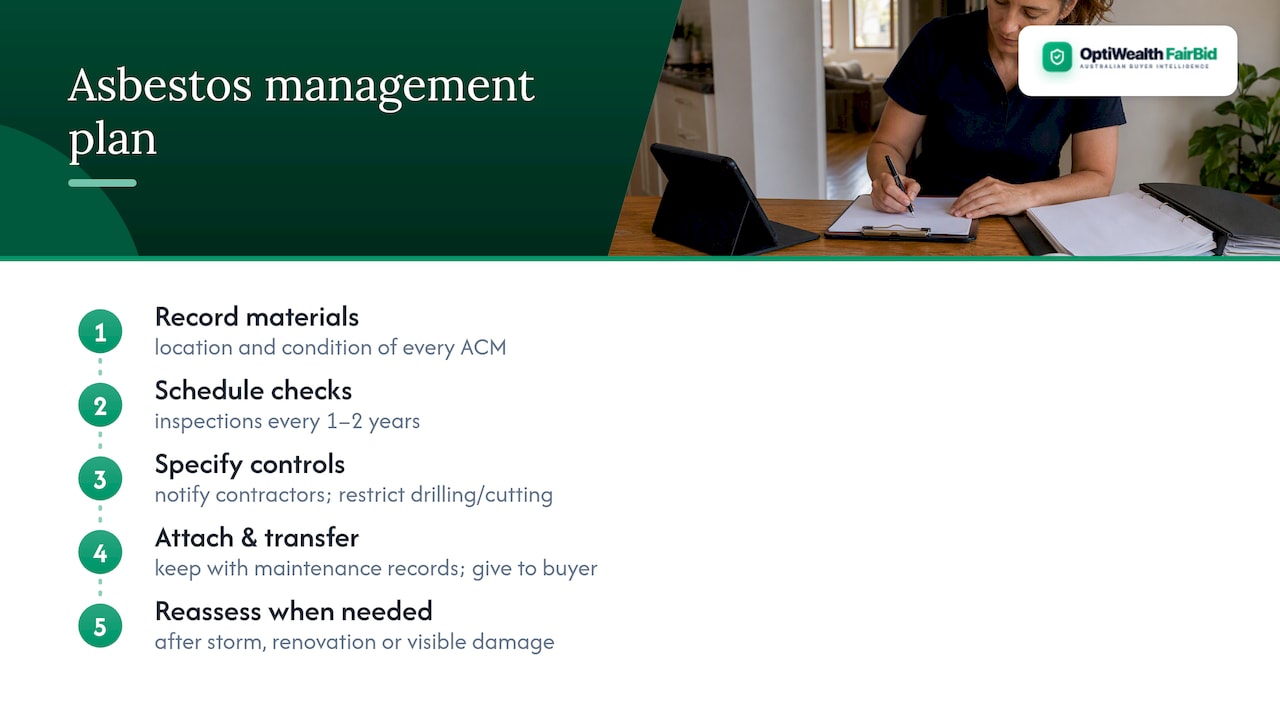
A management plan is not a substitute for assessment: it only works once the material has been properly identified and tested, and it should be revisited whenever the property’s condition changes materially, such as after storm damage, a renovation nearby, or visible deterioration of the sheeting itself. For many owners of older fibro-era homes, a well-documented management plan is a more proportionate response than wholesale removal of materials that pose little risk while undisturbed.
Treating asbestos as a quantifiable property risk, not a verdict
Asbestos in an older Australian home is common, not catastrophic, and the right response is documentation rather than alarm. A well-assessed, well-managed ACM is a material latent defect to be priced and scheduled, not an automatic reason to walk away from an otherwise sound property.
For buyers facing auction conditions or an unconditional offer, commissioning a targeted asbestos assessment before exchange lets you adjust price, add conditions, or plan remediation timelines with evidence rather than guesswork. An independent audit that places the asbestos finding alongside other latent risks, structural issues, zoning overlays and holding costs, gives a far clearer basis for a single, evidence-led decision.
— JeongSuk Lee
Centralising asbestos risk with your broader property due diligence
An asbestos assessment answers one question well. It does not tell you whether the asking price reflects genuine market value, whether a flood or bushfire overlay sits on the title, or what a looming special levy might cost the body corporate. OptiWealth FairBid brings those latent risks into a single independent audit report, built on spatial AI modelling rather than agent-supplied figures, so you can read your asbestos findings against structural defects, council overlays and underquoting signals in one place.

FairBid does not replace a licensed asbestos assessor’s report; it sits alongside one, helping you quantify what remediation or ongoing management might mean for your holding costs and your negotiating position.
| What you need | Where to get it |
|---|---|
| Asbestos sampling and condition report | Licensed asbestos assessor, NATA-accredited laboratory |
| Independent market valuation and risk audit | OptiWealth FairBid sample report |
| Printable audit for negotiation or finance | OptiWealth FairBid quantitative audit |
Our Free Tier gives you a starting view of a property’s risk profile at no cost, and our Paid Advocate Tier unlocks the full audit report for a specific address; current prices are available on our pricing page. Order a sample audit before your next inspection to see what it flags.
FAQ
How do I know if my house has asbestos in Australia?
Age is the strongest signal: homes built or renovated before 1990 are highly likely to contain asbestos-containing materials. You cannot confirm this by sight alone, so the reliable method is sampling by a licensed assessor and testing at a NATA-accredited laboratory.
Will 30 minutes of asbestos exposure hurt you?
A single brief exposure to intact, undisturbed asbestos carries low risk, but there is no safe threshold for inhaled fibres once material is disturbed. The health concern comes from cumulative or high-intensity exposure, such as during drilling or sanding, which is why any disturbance should be avoided until the material is assessed.
Can you sell a house with asbestos in Australia?
Yes, a property with known or documented asbestos can be sold; most ACMs are low risk if left undisturbed and many older Australian homes contain some. Disclosure requirements vary by state, so sellers should check what their Section 32 or vendor statement needs to include and provide any existing assessment or management plan to prospective buyers.
Would a house built in 1976 have asbestos in Australia?
A home built before 1990 falls within the period when asbestos-containing materials were in widespread use, so it is highly likely to contain some ACMs in sheeting, flooring or roofing. An assessment before any renovation work is the only reliable way to confirm which materials are affected and whether they are friable or non-friable.
Sources
For primary guidance, start with the Asbestos Safety and Eradication Agency for national advice, your state EPA or WHS authority for disposal and licensing rules, and a NATA-accredited laboratory for confirmed testing. These sources set the legal minimums that any assessment or removal must meet.
- Householders and home renovators — Asbestos Safety and Eradication Agency
- Asbestos
- Dealing with household asbestos — EPA NSW
- Health
The information provided in this publication is for educational and general information purposes only and does not constitute financial, investment, taxation, or legal advice under the Corporations Act 2001 (Cth). Property buyers and investors should conduct independent physical, legal, and strata due diligence and seek advice from a licensed financial advisor, solicitor, or conveyancer tailored to their personal objectives before entering into any legally binding contract of sale.
OptiWealth Research
Transparent Data Science & EngineeringData Science, Software Architecture & Mathematical Risk Modeling Group
Authored by OptiWealth’s Quantitative & Data Engineering division. Our team specializes in full-stack software architecture, open-source data science, and spatial econometric property valuation (such as hedonic price regression, environmental zoning overlay synthesis, and cash-flow yield analytics). All underlying algorithms and calculation formulas are fully transparent, open to inspection, and designed purely for financial and property data visualization.
Expose Hidden Property Risks & Liabilities
OptiWealth replaces guessing games with algorithmic diagnostics. Use FairBid to audit council overlays, building defects, and calculate true net property yields.